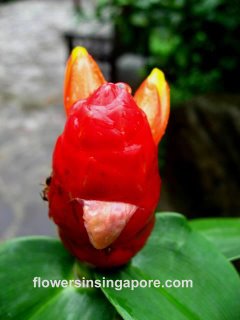
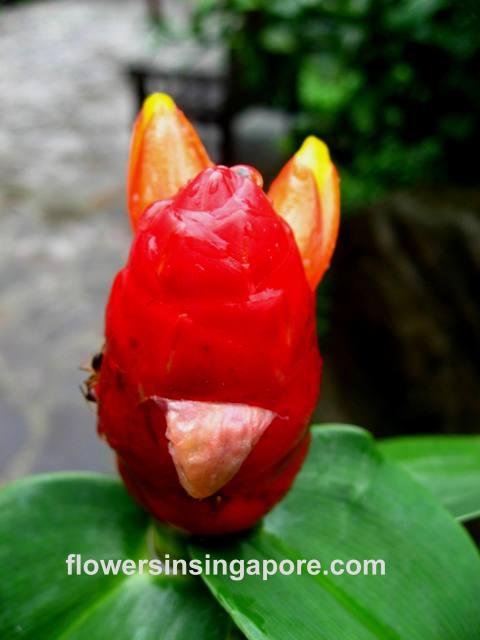
I am not 100% sure about the identity of this plant but it looks like it is the costus woodsonii belonging to the ginger family. The photo was taken in the Ginger Garden of the Singapore Botanic Garden and I shall check on the label next time. Anyway, this is such a cheeky presentation that I thought that it would be good to tie up the image with what I have read recently in a book by Lin Yu Tang on "The Importance of Living" where he compares how the brains of a humorist and a theorist work. Interesting! I cannot agree more nor can I express it better. Some soul food to nourish our brains:
"Generally, a humourist keeps closer touch with facts, while theorist dwells more on ideas, and it is only when one is dealing with ideas in themselves that his thoughts get incredibly complex. The humourist, on the other hand, indulges in flashes of common sense or wit, which show up the contradictions of our ideas with reality with lightning speed, thus greatly simplifying matters. Constant contact with reality gives the humourist bounce, and also a lightness and subtley. All forms of prose, sham, learned nonsense, academic stupidity and social humbug are politely but effectively shown the door. Man becomes wise because man becomes subtle and witty. All is simple, all is clear. It is for this reason that I believe a sane and reasonable spirit, characterized by simplicity of living and thinking can be achieved only when there is a very much greater prevalence of humorous thinking."~ Lin Yu Tang in "The Importance of Living".


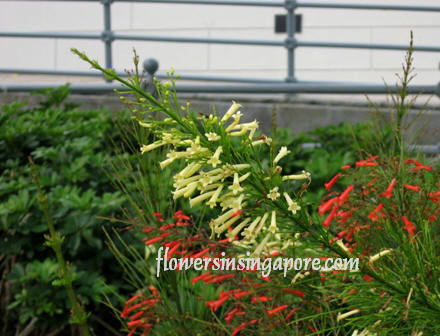

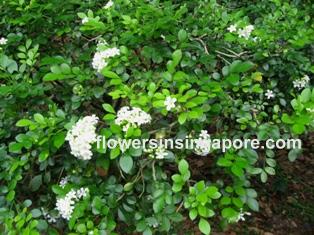
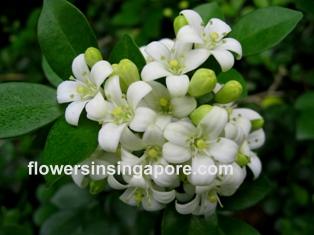
 This flower may not thrive in Singapore because it is found in colder climates. There are as many as 25 species and they are found in North America, Europe, Northern Africa and Western Asia. I photographed this shrub half-way up Genting Highlands in Malaysia. It was growing on a slope next to a pagoda on the grounds of a Chinese temple that was housed in a cave. What caught my eye amongst the thick foliage was the creamy white flowers that looked good enough as the centrepiece of a dinner table. This lovely bouquet was beyond my reach but not that of the zoom lens of my Olympus C-750. I never found out the name till now.
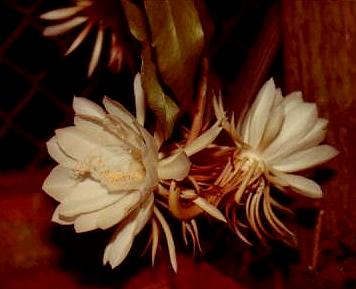
  Age shows in this photo as it was taken several years ago in my mother's garden. I used to call this flower the midnight flower because it only blooms at around 11pm and I will always remember the fragrance exuding from this lovely flower that the Chinese call 'Keng Hua". This plant is a kind of cactus and does not need soil to grow. I remember that some of my classmates from my childhood used the flat leaves as bookmarks.
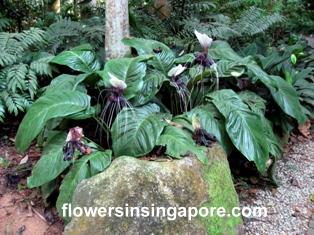 The photo below is a portrait of the freshest member of this Bat Lily community in Bukit Batok Nature Reserve. I also made a discovery that the Bat Lily is made up of bracts that are of two types - The showy bracts at the top and the whisker-like ones at the bottom - as well as an inflorescence comprising several flowers.
 Here's a close up of the flowers in the inflorescence:
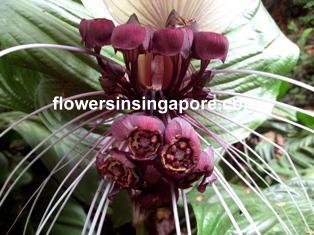 Each flower has 3 petals that are pulled back to reveal the stamens and style.
 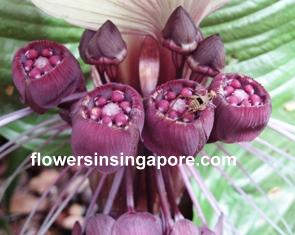 Here's a flower that looks more like a flower than a receptacle for seeds.
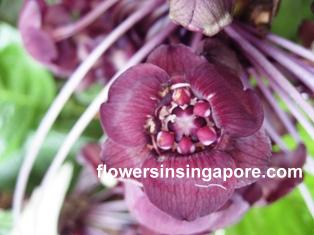 As the flower matures this is what is looks like: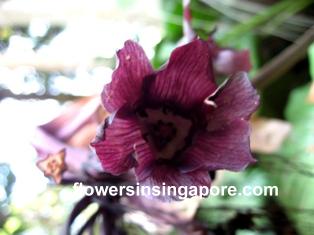
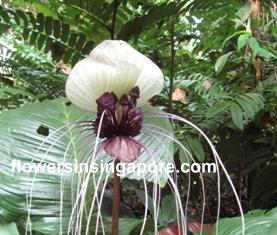 I almost missed seeing these two bat lilies for they were hidden by some huge ferns. When I saw them, it brought back that joy of finding something wonderful when you least expect it.
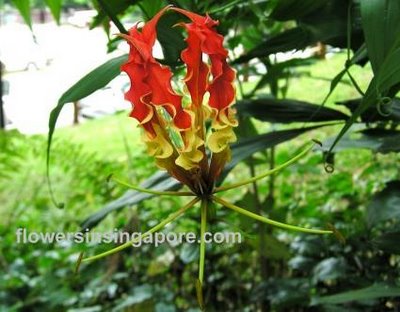
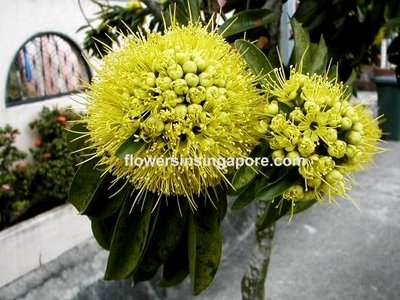
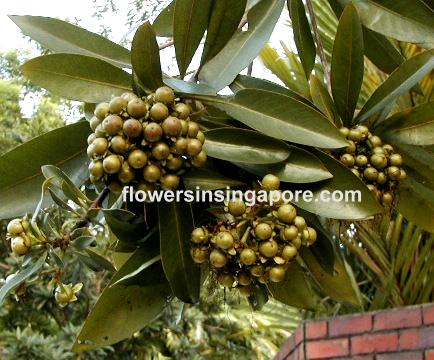
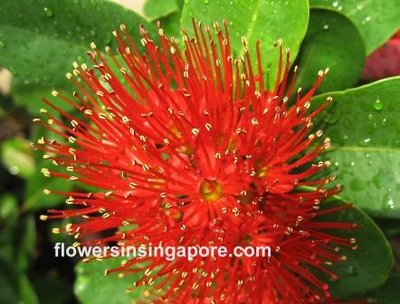 This flower and the fruits are similar to
  the Golden Penda. I searched the internet for images of this flower using "Xanthostemon" and "penda" as the key words but could not find any. The closest that I got was a flower called "Crimson penda" but there were no pictures.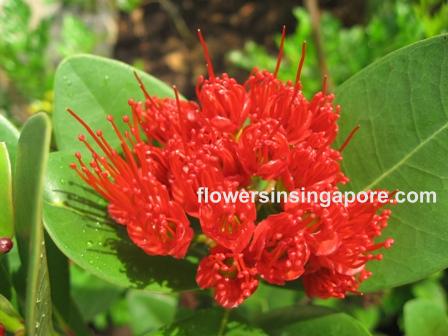
 I came across images of a flower from New Zealand that looks similar but I cannot be sure. It is called metrosideros umbellatus or Southern Rata.