Tuesday, March 14, 2006

Osmoxylon lineare

Family: Araliaceae
Common name: Miagos bush


The first time I saw this type of flower was in the Botanic Garden. It surprised me that a plant that I'd always thought was non-flowering was able to produce such interesting bunches of bud, flower and fruit combinations. Since that time, I have begun to take notice of this shrub and have been rewarded sufficiently with opportunities to record its flowers in various stages of blooming.

Saturday, March 11, 2006

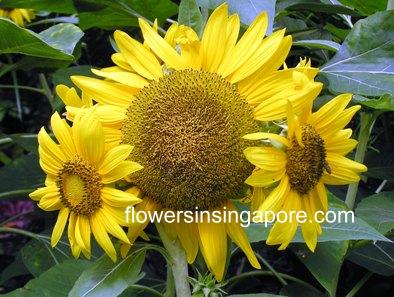
Helianthus annus - Sunflower

Family: Compositae
Origin: Western United States of America
The first story book that my mum bought for me when I was a child was about a sunflower that grew in a garden. It grew next to a humble daisy and when it achieved an impressive height it scoffed at the tiny flower from high above criticising it for being so insignificant.
One day a storm blew up and broke the back of the once mighty sunflower and it crashed down to earth and came face to face with the tiny daisy. The moral of the story is 'Pride goes before a fall'. Always remain humble in life no matter what your achievements or successes are.

Azadirachta indica (Neem Tree)

The first time I heard about this tree was from a friend who told us about a kind of tea he was introduced to that came from the leaves of this tree and that it came from Burma. The second time was when I read about in the book "Trees of our Garden City". I learned that there is also a Giant Neem Tree called Sentang in Malay and this tree could grow up to 50 metres in height. It is believed have medicinal value and is also used for making furniture. When I went to India last year I saw giant neem trees by the roadside. In contrast there is a slender tree in a friend's garden that never seems to 'put on weight' although it keep growing taller and taller. One day, it flowered and here is the evidence of that flowering:

Common Name: Neem Tree or Nim Tree
Origin: India and Java

Pachystachys lutea

Common Name: Golden Candles
Origin: Tropical Central & South America
These shrubby plants can be grown in pots and are commonly seen during Chinese New Year in nurseries because the 'flowers' give the impression of pots of gold. Actually the flowers are the small white ones but the yellow bracts give the impression that the flower is more than that. This was a plant I had some years ago that did not survive probably because we did not give it enough water or nourishment. All I have are the photos to remind me not to grow plants that require a lot of care and attention.

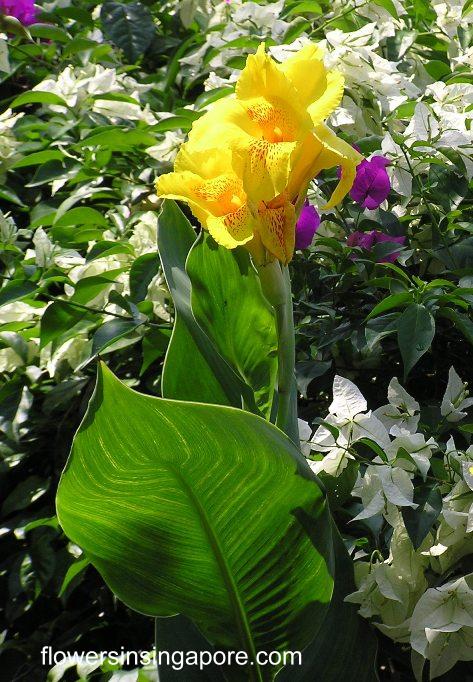
Canna - (美人蕉 - mei3 ren2 jiao1)

Canna
Family: Cannaceae
Origin: Tropical America, Carribean

This is a popular flowerbed type of plant giving garden landscapes splashes of colours in yellows, reds, pinks and orange. They are brilliant in bright sunshine but when the flowers are on the decline, they do not make a pretty sight. I do not think that I would like to have them in my garden for though they may provide a cheerful environment when they are blooming, they require much work after that. It is depressing to see wilting flowers and the only way is to maintain the flowerbed well by cutting away the faded blooms and re-planting them after some time.

Saturday, March 04, 2006

Schefflera actinophylla (Umbrella Tree)

Schefflera actinophylla (Umbrella Tree)

Family: Araliacceae
Australia Ivy Palm, Umbrella Tree
Origin: Tropical Australia, Papua New Guinea

This is the hardest flower to photograph as they bloom right at the top of the tree and these trees are really tall. I have yet to capture a super sharp picture of the flowers and this remains my quest for perfection to this day with regards to photograhing this flower. Another flower that I always have difficulty with is the African Tulip.

Wednesday, March 01, 2006

Vanda Miss Joaquim

This orchid hybrid is the national flower of Singapore. I am not a fan of orchids and usually I would not photograph them unless they are extraordinary like the Tiger Orchid posted in an earlier entry in this blog. In this instance I was attracted by the mass blooms here:

Details of this flower are found in the National Park Board of Singapore:
http://www.nparks.gov.sg/plants/van/pla-van-van.shtml